Understanding The Engage Dashboard
The Engage dashboard is Statusbrew's social inbox, where you read, reply to, and manage comments, messages, mentions, and reviews from all your connected social profiles in one place.
What Is The Engage Dashboard?
Engage brings every conversation from your connected profiles into one inbox. From one screen you can sort conversations into inboxes and views, reply, add internal notes, assign work to teammates, and see who you're talking to.
To open it, click Engage from the Statusbrew dashboard.
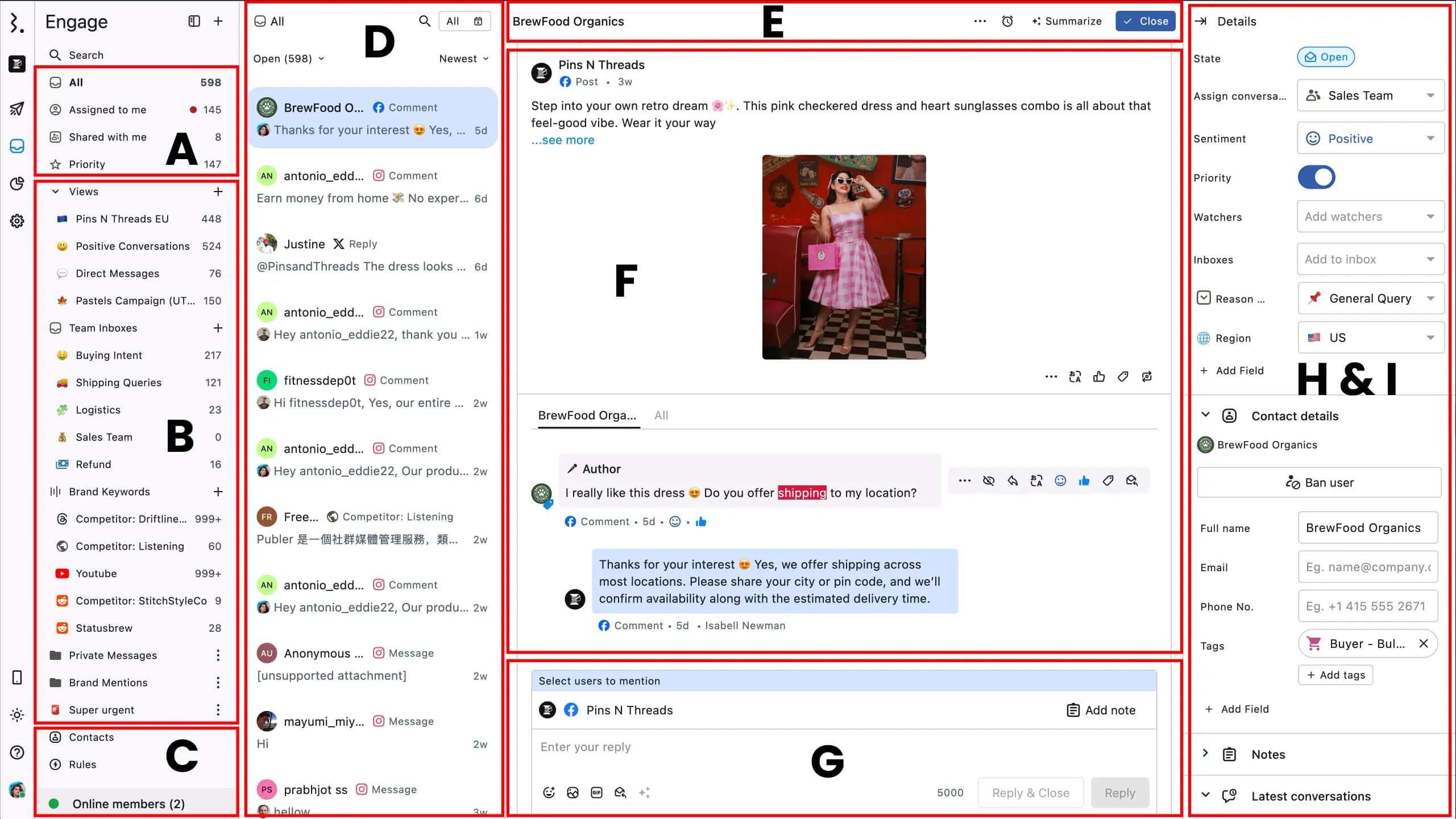
The screen has four parts, from left to right: the sidebar, the conversation list, the open conversation with its reply box, and the Details panel. The letters in the headings below match the screenshot.
Why Engage Looks Different For Each User
Engage only shows you what you have access to, so two people in the same space can see different inboxes and conversations.
Conversations: All and your other default inboxes only show conversations from the social profiles you have access to. Your access to each profile also decides whether you can only view conversations or also reply and take action on them.
Views and Brand Keywords: You only see the ones shared with you, either with all team members or with you or your user group directly. A view shared with you shows every conversation that matches its filters, even from profiles you otherwise can't access, so share views only with the people who should see them.
Team Inboxes: Regular Users only see the team inboxes they've been added to. Being added gives you access to every conversation in that inbox, even from profiles you otherwise can't access. Admins and Owners see all team inboxes.
Admin and Owner options: Rules in the sidebar, Brand Keywords and Create folder in the menu, and Add Field in the Details panel only show for Admins and Owners.
If something is missing for you, ask an Admin to give you access to the profile or share the view or team inbox with you.
Sidebar And Default Inboxes (A)
The sidebar on the left lists every inbox you can open. At the top are your default inboxes:
All: Every conversation from the profiles you can access.
Assigned to me: Conversations assigned to you.
Shared with me: Conversations where you were added as a watcher or mentioned in an internal note.
Priority: Conversations marked as priority.
The number next to each inbox is its count of open conversations. A red dot on Assigned to me and Shared with me means there are unread conversations in that inbox.
Use Search at the top of the sidebar to find an inbox by name. Click (Create options) to create a new view or team inbox. Admins and Owners also see Brand Keywords and Create folder in this menu.
To hide or show the sidebar, click (Toggle sidenav) or press [.
Folders (B)
Below the default inboxes, your inboxes are grouped into folders.
Default folders: Every space starts with three: Views (saved filters), Team Inboxes (shared inboxes your team routes conversations into), and Brand Keywords (listening results for your tracked keywords, hashtags, and mentions).
Custom folders: Admins and Owners can create their own folders to group views, team inboxes, and Brand Keywords by client, campaign, or team. Drag and drop to move inboxes between folders or reorder them.
Hover over any view and click More (three dots) to Edit, Duplicate, or Delete it.
Learn more in Engage Views.
Learn more in What Are Team Inboxes In Engage.
Add-Ons (C)
At the bottom of the sidebar you'll find:
Contacts: Your social CRM, with everyone who has interacted with your profiles.
Rules: Opens the Rule Engine to automate actions on incoming conversations. Only Admins and Owners see this.
Online members: Shows how many teammates are online right now. Click it to see who.
Conversation List (D)
The middle column lists the conversations in the inbox you opened. Each row shows the contact's name and picture, the profile or keyword the conversation came from, a preview of the message, and how long ago it arrived. Unread conversations are highlighted until you open them.
The bar at the top of the list has these controls:
Search: Opens Search conversations, where you can find conversations by keyword within a date range.
Date range: Shows conversations from a set period, such as the last 28 days, or a custom range.
State: Switch between Open, Close (closed conversations), and Snoozed. The count next to it shows how many conversations match.
Sort: Order the list by Newest, Oldest, Recently replied, Waiting longest, or Priority first.
Hover over a conversation in the list and click (Close) to close it, or (Re-open) on a closed or snoozed conversation to open it again.
Learn more in How Can I Filter Conversations In Engage?
Conversation Actions (E)
The bar above the open conversation shows the contact's name on the left and these actions on the right:
More (three dots): Conversation history (every action taken on the conversation), Copy conversation link (for sharing inside your team), and Share via email.
Snooze: Hide the conversation until a time you choose.
Summarize: Get an AI summary of a long conversation. You can refresh the summary or copy it.
Close: Mark the conversation as done, or press y. On a closed or snoozed conversation, this button reopens it, or press o.
Details panel toggle: Show or hide the Details panel on the right.
Learn more in Using Keyboard Shortcuts In Engage.
Conversation View (F)
The open conversation shows every message in order, along with replies and internal notes from your team. Hover over the top of the conversation to add a title, which also shows in the conversation list.
Hover over a message to see its actions. Depending on the network, you can:
Translate: Translate the message.
Sentiment: See and change the message's sentiment.
Like or react: On LinkedIn, X, and Facebook.
Repost: On LinkedIn, Facebook, X, and Instagram.
Tag: Add message tags.
Macro: Apply macro actions.
More (three dots): Hide, delete, or reply privately to a comment, where the network supports it.
Learn more in Social Network Based Conversations Actions.
How Do I Open A Post Or Comment On The Social Network?
Below each message you'll see the conversation type and a timestamp. Click the timestamp to open that comment or message on the social network. For the post itself, click the timestamp below your profile name at the top of the conversation.
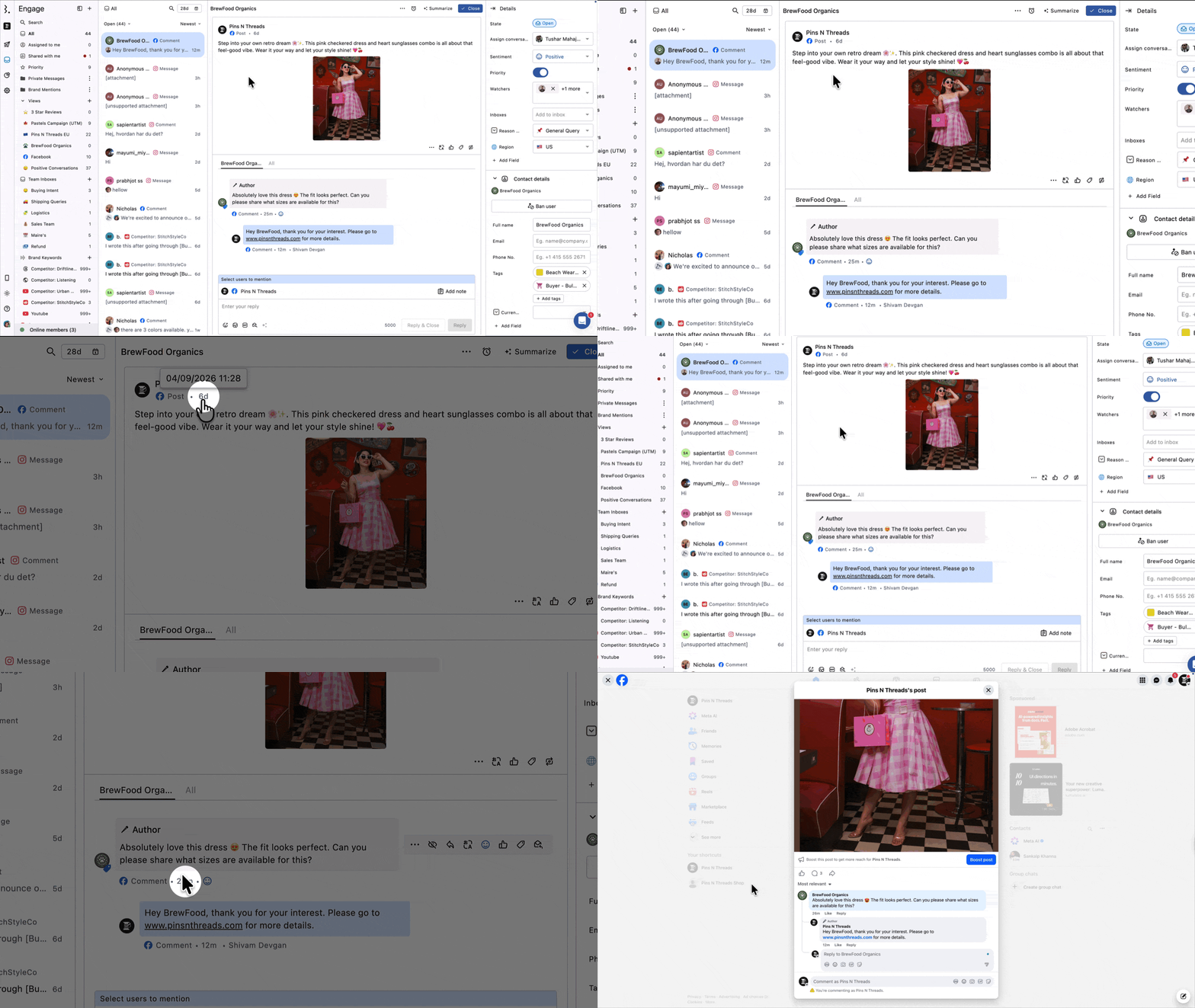
This works for comments on Facebook, Instagram, LinkedIn, and YouTube, replies on X and Threads, and mentions and Brand Keyword conversations on all supported networks.
Post Actions
For comments on your own posts, the post appears at the top of the conversation. You can translate it, tag it, apply macros, like it, or repost it. Tags on the post show below it; hover over a tag and click (Remove) to remove it.
Click More (three dots) on the post for:
Disable comments: Turn off comments on the post.
Create inbox view: Create a view with only this post's conversations.
Resync comments: Pull older comments into Engage.
Delete: Remove the post content from Statusbrew.
Click All next to the contact's name to see every comment on the post. From there, click Select all to act on many comments at once.
Reply Box (G)
The reply box at the bottom is where you answer the conversation.
Reply: Send your reply to the contact.
Reply & Close: Send your reply and close the conversation in one step.
Add note: Switch to an internal note that only your team sees. Type @ to mention a teammate.
The reply box also has buttons for emoji, media, and macros, and shows how many characters you have left.
Learn more in Replying To Conversations.
Details Panel (H)
The Details panel on the right has two parts.
Conversation details show and let you change:
State: Open, closed, or snoozed
Assign conversation: The teammate or user group handling it
Sentiment: Positive, neutral, or negative
Priority: Toggle on to send it to the Priority inbox
Watchers: Teammates who follow the conversation (it appears in their Shared with me)
Inboxes: The team inboxes the conversation is in
Custom fields: Any conversation fields your team has set up. Admins and Owners can add new ones with Add Field.
Contact details show who you're talking to:
Name, email, and phone number, which you can edit
Contact tags that describe the person (not the conversation)
Contact custom fields
Notes your team has added about the contact
Latest conversations with the same contact
Ban user for Facebook contacts
Learn more in Conversation Details And Contact Sidebar.
FAQs
Why Can't I See Rules In My Engage Sidebar?
Rules only appears for Admins and Owners. If you're a Regular User, ask an Admin to create or change rules for you.
Why Don't I See All Conversations In The All Inbox?
All only includes conversations from the social profiles you have access to. Ask an Admin to give you access to the missing profile. Also check the state (Open, Close, Snoozed) and the date range at the top of the list, since both limit what you see.
What's The Difference Between Shared With Me And Assigned To Me?
Assigned to me shows conversations you're responsible for. Shared with me shows conversations where a teammate added you as a watcher or mentioned you in a note, so you can follow along without owning them.
Where Did The Contact Sidebar Go?
Contact information is now in the Details panel, below the conversation details. Scroll down to Contact details to see the contact's info, tags, notes, and latest conversations.
How Do I Hide The Sidebar Or The Details Panel To Get More Space?
Click (Toggle sidenav) at the top of the sidebar or press [ to hide the sidebar. Click the panel icon at the top right of the conversation to hide or show the Details panel.
How Do I Find An Old Conversation?
Click at the top of the conversation list, next to the date range, to open Search conversations. Type the exact message text or a unique keyword, press Enter, and set the date range to cover when the conversation happened. The Search at the top of the sidebar only finds inboxes by name, not messages.
What Does The Number Next To Each Inbox Mean?
It's the number of open conversations in that inbox. Closed and snoozed conversations aren't counted. Once an inbox has more than 999 open conversations, the count shows as 999+. For an exact number, open a narrower view or use Conversation Count in Reports.
Why Can't My Teammate See A View Or Team Inbox That I Can See?
Views and Brand Keywords only show for people they're shared with. Whoever created the view can edit it and change Share access with. For a team inbox, an Admin needs to add your teammate to it.
Why Is The Reply Box Orange?
An orange reply box that says "Start typing @ to mention team members" is an internal note, which only your team sees. You see this when you don't have reply access to the profile, or when the conversation type doesn't support replies, such as an Instagram post your profile was tagged in.
Why Can't I Create A Folder Or Brand Keyword?
Only Admins and Owners see Create folder and Brand Keywords in the menu. Regular Users can create views and team inboxes.