While doing your research for the best time to post on Instagram in 2026, you’ve probably noticed some inconsistencies: every blog gives a slightly different answer.
Some say 9 AM.
Some say 11 AM.
Others say evenings
The truth is, there is no “magic hour/ slot” on any social media that can help you get a "Wow" like reach or engagement.
What it does have are repeatable engagement slots driven by users' behavior, which show up consistently across multiple independent studies.
There are 3B+ monthly active users on Instagram. That is over 35% of the world population.
That's why some slots work for some people, and some don't.
Now, to get better results, it's a great idea to understand your social profile's analytics and tracking those numbers using a social media analytics tool will help in reality.
Experimenting with your own data and publicly available suggestions can take you to a meaningful & logical answer.
In this guide, we analyzed:
Independent global usage research
Large-scale Instagram engagement benchmarks
Cross-verified patterns from 2025–2026 timing studies
Meta’s own statements about ranking and distribution
And how you can track your own profiles & get deep analytics to help you understand your best time to post.
How Did We Do This Research?
Many best-time-to-post blogs rely on a single study or recycle older charts.
For this 2026 update, we cross-referenced three data types to identify patterns that consistently occur.
1. Independent Social Media Usage Research
Before identifying specific posting windows, it’s important to understand how people actually use social media in 2026.
According to the latest global usage research, there are approximately 5.66 billion social media users worldwide, representing nearly 64% of the global population as of late 2025.
That level of adoption means engagement behavior is driven by everyday usage rather than isolated spikes.
The same research indicates that the average person spends over 2 hours per day across social platforms, and that time is typically spread across multiple short mobile sessions rather than a single long continuous visit.
It explains why engagement tends to cluster around predictable daily windows:
Mid-morning check-ins
Lunch-hour scrolling
Early evening wind-down sessions
Instagram’s audience behavior further reinforces this pattern.
According to Backlinko, People spend an average of 33.9 minutes a day on Instagram.
Younger audiences are especially known for:
Frequent app check-ins throughout the day
Strong evening usage
High short-form content consumption
When you combine:
Massive global adoption
2+ hours of daily social usage
33 mins daily on Instagram only
A young, highly active user base
You begin to see why certain posting windows consistently outperform others.
But, which time slots? That's a big question.
2. Large-Scale Instagram Engagement Studies
Now that we understand, with data, how people use social media, the next step is platform-level engagement data.
Usage statistics tell us when people are online.
Engagement studies tell us when people actually interact.
These reports analyze:
Millions of Instagram posts
Hour-by-hour engagement performance
Industry-level timing variations
Heatmap-based interaction density
Unlike general usage statistics, these datasets measure real actions:
Likes
Comments
Saves
Shares
Reach
For example:
Buffer’s 2026 timing research explains aggregated post performance across its global user base
Later’s Instagram timing update studied millions of scheduled content to detect engagement trends
As per these reports, the following time slots show higher engagement rates:
Late morning
Midday/lunch hours
Early evening
This layer translates broad usage behavior into measurable performance signals.
It moves us from:
“People are active.” to “People are engaging.”
3. Cross-Verification from 2026 Timing Analyses
Individual engagement studies are nice; however, no single report should define a universal “best time.”
Each publisher:
Uses different datasets
Analyzes different industries
Applies slightly different engagement metrics
Focuses on different regions
That’s why we conducted cross-verification.
Instead of relying on one study, we mapped the recommended posting windows across multiple independent 2025–2026 analyses, including:
Buffer
Later
Iconosquare
Influencer Marketing Hub
Adobe Express
Expert Market
We then:
Listed each study’s recommended posting times
Grouped them into hourly ranges
Highlighted overlaps appearing in three or more reports
Filtered out one-off outliers
This allowed us to move away from exact-minute claims and identify high-consensus engagement slots.
The Best Time to Post on Instagram in 2026
After analyzing all these studies, we found that the 3 time slots consistently appear across multiple independent studies.
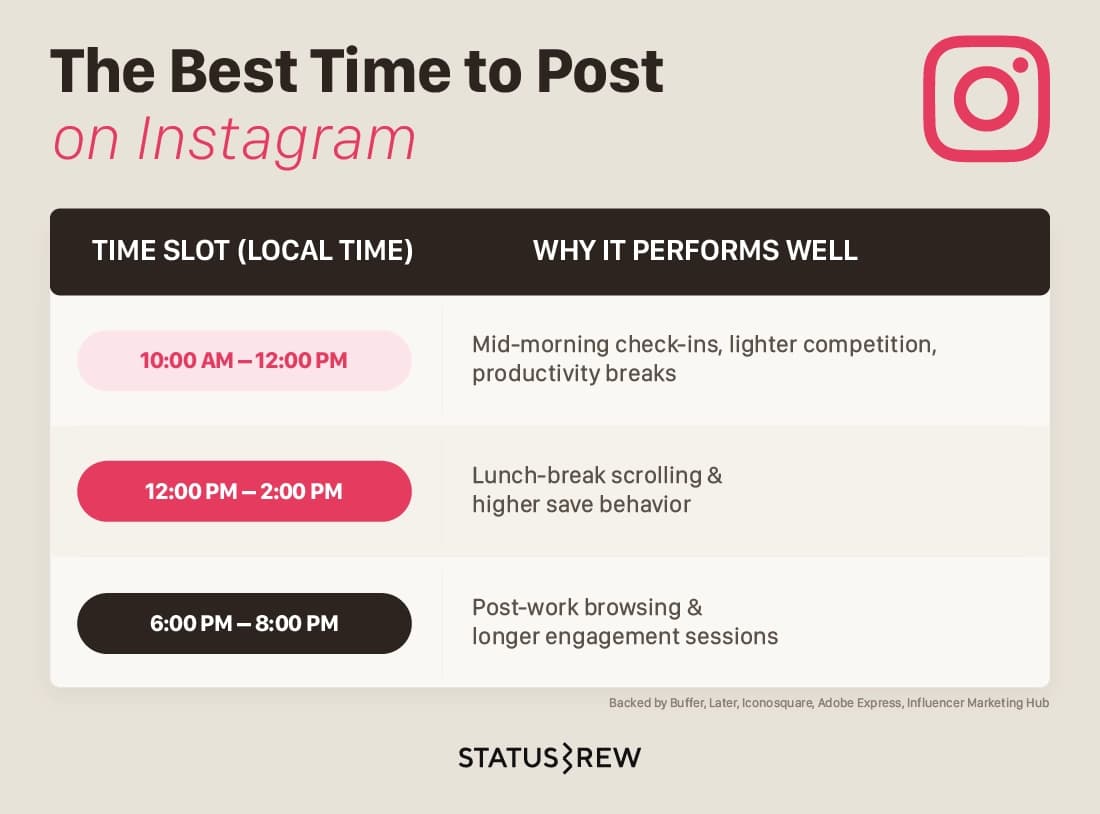
When independent datasets converge around similar time bands, it signals behavioral consistency rather than coincidence.
What the Studies Actually Say:
1. 10:00 AM – 12:00 PM (Mid-Morning Peak)
Buffer’s 2026 update shows posting around 10–11 AM performs consistently across industries
Iconosquare’s updated research also points to late-morning engagement strength
Why is this working? People check Instagram at the start of their day, during coffee breaks, and between work tasks.
2. 12:00 PM – 2:00 PM (Lunch Scroll Window)
Later’s 2026 Instagram timing update highlights lunch hours as high-performing
Expert Market’s multi-industry social timing study also shows lunchtime engagement spikes
Why is this working? Users scroll casually during lunch breaks and are more likely to save content for later.
3. 6:00 PM – 8:00 PM (Evening Engagement Peak)
Adobe Express’s cross-platform timing analysis identifies early evening as a strong engagement window
Influencer Marketing Hub’s 2026 Instagram timing data also shows strong evening activity
Why this window works: Users are at home, relaxed, and browsing for longer, leading to greater engagement.
Important: These Are Global Averages
These time slots are based on:
Large aggregated datasets
Multi-industry averages
Millions of posts analyzed
But they are not universal.
For example:
A B2B SaaS brand may perform better at 11 AM on weekdays.
A lifestyle creator may peak at 7:30 PM.
A fitness brand might win at 6 AM.
This is why global benchmarks are starting points, not final answers.
Best Day to Post on Instagram in 2026
Across timing studies, Wednesday is the most frequently cited highest-performing day, followed closely by Tuesday.
Why?
Because this is Midweek:
Work routines are stable now
Weekend distractions haven’t started
Engagement patterns can be predicted
Performance during weekends tends to be more volatile and audience-specific.
Important Context
These recommendations are based on:
Aggregated global datasets
Multi-industry averages
Millions of posts analyzed
They are starting points, not guarantees.
A B2B brand, a fitness creator, and a fashion influencer will not share identical performance peaks.
I think you can start with 10 AM – 12 PM on Tuesday or Wednesday, since they use different data sets.
Best Time to Post on Instagram by Weekday
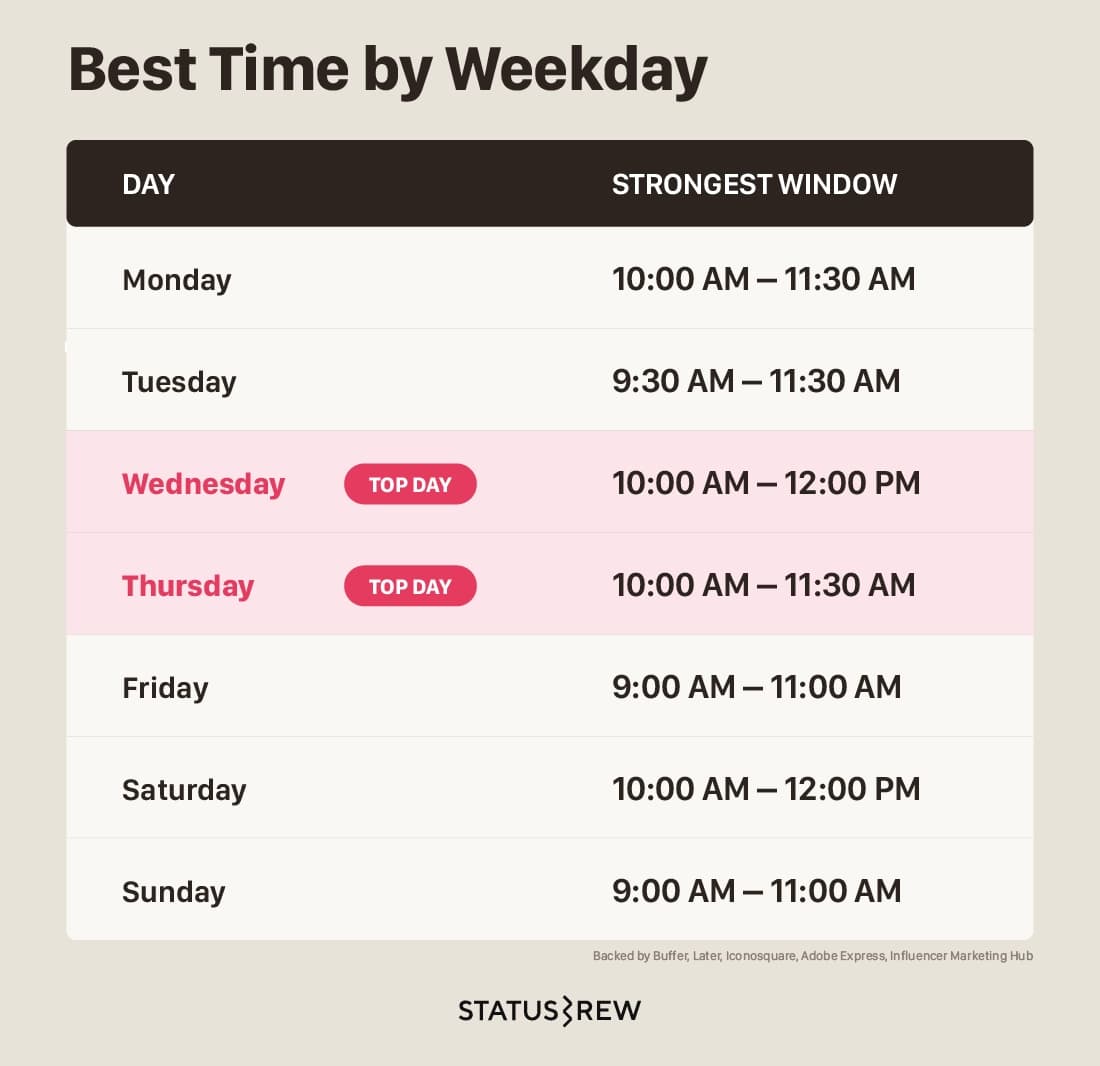
While mid-morning and early evening are strong performers in general, the patterns shift slightly throughout the week.
Below is a weekday breakdown. All times are shown in your local time zone.
Monday
Time Slot | Engagement Trend | Context |
|---|---|---|
10:00 AM – 11:30 AM | High | Start-of-week check-ins between tasks |
6:00 PM – 7:00 PM | Moderate | Light post-work browsing |
Monday is steady but not peak-performing. Works well for educational or professional content.
Tuesday
Time Slot | Engagement Trend | Context |
|---|---|---|
9:30 AM – 11:30 AM | Very High | Strong mid-morning activity |
12:00 PM – 1:30 PM | High | Lunch-hour engagement spike |
6:00 PM – 8:00 PM | Moderate–High | Consistent evening browsing |
Tuesday consistently ranks among the strongest engagement days.
Wednesday
Time Slot | Engagement Trend | Context |
|---|---|---|
10:00 AM – 12:00 PM | Peak | Highest cross-study overlap |
12:00 PM – 2:00 PM | High | Lunch scroll window |
7:00 PM – 8:00 PM | Moderate | Relaxed midweek browsing |
Wednesday shows the most stable engagement density across industries.
Thursday
Time Slot | Engagement Trend | Context |
|---|---|---|
10:00 AM – 11:30 AM | High | Similar to midweek patterns |
12:00 PM – 2:00 PM | High | Reliable lunch engagement |
6:00 PM – 7:00 PM | Moderate | Pre-weekend browsing increases |
Thursday remains strong but slightly less predictable than Wednesday.
Friday
Time Slot | Engagement Trend | Context |
9:00 AM – 11:00 AM | Moderate–High | Morning scroll before weekend mindset |
12:00 PM – 1:00 PM | Moderate | Shorter lunch sessions |
Engagement drops earlier in the evening than on midweek days.
Saturday
Time Slot | Engagement Trend | Context |
10:00 AM – 12:00 PM | Moderate | Late wake-up scroll |
6:00 PM – 8:00 PM | Moderate | Casual evening browsing |
Weekend performance varies widely by industry (lifestyle and creator industries often perform better).
Sunday
Time Slot | Engagement Trend | Context |
9:00 AM – 11:00 AM | Moderate | Slow morning scroll |
6:00 PM – 7:30 PM | Moderate–High | “Sunday reset” browsing before week begins |
Sunday evening often outperforms Sunday afternoon.
Weekly Snapshot (Quick Reference)
Day | Strongest Window |
|---|---|
Monday | 10:00 AM – 11:30 AM |
Tuesday | 9:30 AM – 11:30 AM |
Wednesday | 10:00 AM – 12:00 PM |
Thursday | 10:00 AM – 11:30 AM |
Friday | 9:00 AM – 11:00 AM |
Saturday | 10:00 AM – 12:00 PM |
Sunday | 9:00 AM – 11:00 AM |
Best Time to Post on Instagram by Industry
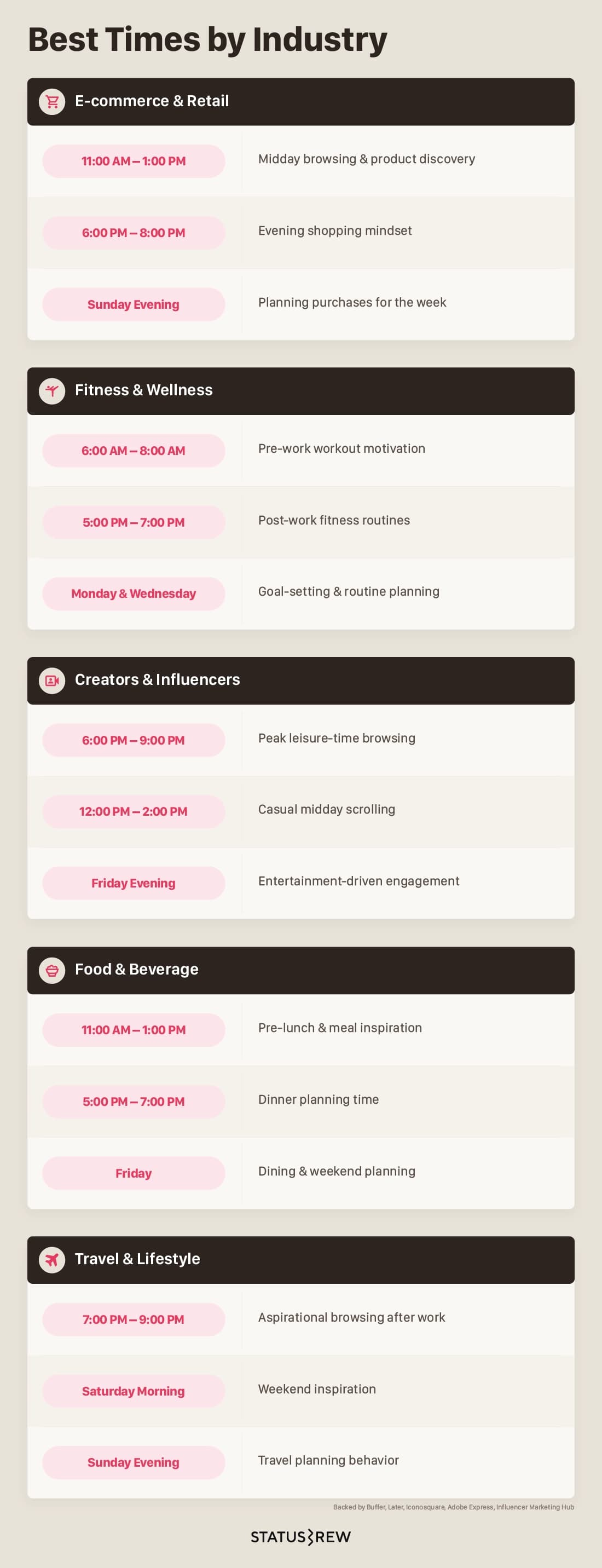
Global benchmarks are great starting points; however, posting trends vary by industry, intent, and even content type.
A retail brand promoting products, a fitness creator sharing workout videos, and a travel account posting destination content will naturally see different engagement patterns.
Even brands like Later, Influencer Marketing Hub, Adobe Express, and Expert Market back this logic.
Below are common timing trends observed across industries.
All time slots are shown in your audience’s local time zone.
E-commerce & Retail Brands
Time Slot | Why It Works |
|---|---|
11:00 AM – 1:00 PM | Midday browsing and product discovery |
6:00 PM – 8:00 PM | Evening shopping mindset |
Sunday evening | Planning purchases for the week |
Retail audiences often browse products during lunch breaks and relaxed evening scrolling sessions.
Fitness and Wellness Brands
Time Slot | Why It Works |
|---|---|
6:00 AM – 8:00 AM | Pre-work workout motivation |
5:00 PM – 7:00 PM | Post-work fitness routines |
Monday & Wednesday | Goal-setting and routine planning days |
Fitness audiences frequently check Instagram around workout times, making early mornings surprisingly effective.
Creators and Influencers
Time Slot | Why It Works |
|---|---|
6:00 PM – 9:00 PM | Peak leisure-time browsing |
12:00 PM – 2:00 PM | Casual midday scrolling |
Friday evening | Entertainment-driven engagement |
Creator content is often consumed during relaxation hours, which explains stronger evening engagement.
Food and Beverage Brands
Time Slot | Why It Works |
|---|---|
11:00 AM – 1:00 PM | Pre-lunch browsing and meal inspiration |
5:00 PM – 7:00 PM | Dinner planning |
Friday | Dining and weekend planning |
Food content naturally aligns with meal cycles, which is why midday and early evening perform well.
Travel and Lifestyle Brands
Time Slot | Why It Works |
|---|---|
7:00 PM – 9:00 PM | Aspirational browsing after work |
Saturday morning | Weekend inspiration |
Sunday evening | Travel planning behavior |
Travel content often performs best during longer leisure browsing sessions.
Key Takeaway
Industry timing differences exist, but two engagement clusters still appear across most sectors:
Mid-morning (9:00 AM – 11:00 AM), when audiences check social media during the day
Early evening (6:00 PM – 8:00 PM), when users browse more casually
Industry benchmarks help you get started, but the most reliable posting schedule comes from tracking engagement data from your own audience over time.
How to Find Your Own Best Time to Post on Instagram
Again, though these standard benchmarks help, tracking your own audience will make more sense and give you the best time to post.
That’s why the best-performing accounts combine industry benchmarks with their own analytics data.
Below are the most reliable ways to determine your ideal posting schedule.
1. Check Instagram Insights
Instagram already provides useful engagement data through Instagram Insights.
You can access it by switching to a Business or Creator account.
Inside Insights, you can view:
Metric | What It Shows |
|---|---|
Most active hours | When your followers are online |
Most active days | Weekly engagement patterns |
Reach per post | How many users saw your content |
Engagement per post | Likes, comments, saves, and shares |
If you notice that most followers are active around 11 AM, posting shortly before that time increases the chances of early engagement.
Early signals of engagement help Instagram’s algorithm distribute content more widely.
2. Track Engagement Patterns Over Time
Instead of relying on one or two posts, analyze patterns across multiple weeks.
Look for repeating signals such as:
Posts published around mid-morning receive more reach
Evening posts are generating more comments
Weekend content is getting more saves
Tracking these patterns across 10–20 posts usually reveals clear engagement trends.
A simple spreadsheet or reporting tool can help you compare:
Post Time | Reach | Likes | Comments | Saves |
|---|---|---|---|---|
10:30 AM | 8,400 | 620 | 48 | 72 |
7:15 PM | 9,900 | 720 | 61 | 84 |
1:00 PM | 6,500 | 510 | 39 | 55 |
Over time, you’ll see which time slots consistently outperform others.
3. Use Social Media Analytics Tools
Instagram Insights works well for basic tracking, but larger accounts often need deeper analytics.
Dedicated social media analytics tools allow you to:
Analyze engagement by posting time
Compare content performance across weeks and months
Identify high-performing time slots automatically
Generate reports showing when your audience interacts most
These insights help remove guesswork and allow brands to build posting schedules based on actual engagement data rather than assumptions.
You can check Statusbrew's Instagram Overview report template which is ideal for understand every aspect of your Instagram content performance.
4. Test Different Posting Windows
Even if research suggests 10 AM – 12 PM performs well globally, it’s still important to test different time slots.
A simple testing approach:
Week | Posting Time | Goal |
|---|---|---|
Week 1 | 10:00 AM | Benchmark performance |
Week 2 | 12:30 PM | Test lunch window |
Week 3 | 6:30 PM | Test evening engagement |
Week 4 | 8:00 PM | Test late browsing |
After several weeks, compare the results and identify the strongest engagement window.
5. Pay Attention to Content Type
Different Instagram formats also perform better at different times.
Content Type | Often Performs Best |
|---|---|
Reels | Evening browsing hours |
Carousels | Mid-morning and midday |
Educational posts | Weekday mornings |
Entertainment content | Evenings and weekends |
Matching content format with audience behavior often improves engagement more than timing alone.
Conclusion
After analyzing global usage research, large-scale engagement studies, and multiple timing analyses, a clear pattern appears.
Most Instagram engagement clusters around three daily windows:
Time Slot | Why It Works |
|---|---|
10:00 AM – 12:00 PM | Mid-morning check-ins and workday breaks |
12:00 PM – 2:00 PM | Lunch-hour scrolling |
6:00 PM – 8:00 PM | Relaxed evening browsing |
Across studies, Tuesday and Wednesday also appear most frequently as the highest-performing days.
However, it’s important to remember that these are global averages, not universal rules.
Your actual best posting time depends on:
Your industry
Your content format
Your follower behavior, etc.
That’s why the most successful Instagram accounts combine global benchmarks with their own analytics data.
Start with the timing windows highlighted in this guide, monitor your audience's engagement patterns, and refine your schedule based on how they actually interact with your content.
Over time, this data-driven approach will help you identify the optimal time to post on your Instagram profile.
FAQs
What is the best time to post on Instagram in 2026?
Most recent engagement studies show that the strongest posting windows are:
10:00 AM – 12:00 PM (mid-morning engagement peak)
12:00 PM – 2:00 PM (lunch-hour scrolling)
6:00 PM – 8:00 PM (evening browsing)
What is the best day to post on Instagram?
Across multiple engagement studies, Wednesday is often the highest-performing day for Instagram posts, followed closely by Tuesday.
Midweek engagement tends to be more stable because people follow predictable routines during the workweek.
Does posting time really matter on Instagram?
Yes, timing can influence engagement.
Posting when your audience is active increases the chances of receiving early likes, comments, and saves, which helps Instagram’s algorithm distribute your content to more users.
However, content quality and relevance still matter more than timing alone.
Is there a universal best time to post on Instagram?
No.
Global timing benchmarks provide useful guidance, but the actual best time depends on:
Your industry
Your follower behavior
Your content type
That’s why analyzing your own account analytics is important.
Is it better to post on Instagram in the morning or evening?
Both can perform well, but for different reasons.
Morning posts (9 AM – 11 AM) benefit from daily check-ins and work breaks
Evening posts (6 PM – 8 PM) benefit from relaxed browsing after work
Many accounts find success posting during both windows.
How often should you post on Instagram?
Most brands and creators see consistent results when posting 3–5 times per week.
Posting consistently matters more than posting every day. Regular content helps maintain audience engagement and algorithm visibility.
How can I find my own best time to post on Instagram?
The most reliable method is to analyze your account’s engagement data.
You can do this by:
Reviewing Instagram Insights
Tracking engagement patterns across posts
Testing different posting times over several weeks
Using analytics tools like Statusbrew to compare performance trends
Over time, these insights reveal the posting windows that work best for your specific audience.
What time do Instagram users check the app the most?
Instagram usage tends to cluster around three daily periods:
Mid-morning (10 AM – 12 PM)
Lunch hours (12 PM – 2 PM)
Early evening (6 PM – 8 PM)
These time windows align with common user behavior such as work breaks, lunch scrolling, and evening relaxation.
Is it bad to post on Instagram late at night?
Posting late at night is not necessarily bad, but engagement may be lower because fewer users are active.
Most large engagement studies show that late-night posting (after 10 PM) typically generates less interaction compared to mid-morning or evening posting windows.
However, late-night posting can still work if your audience is active during those hours or if you target audiences in different time zones.